
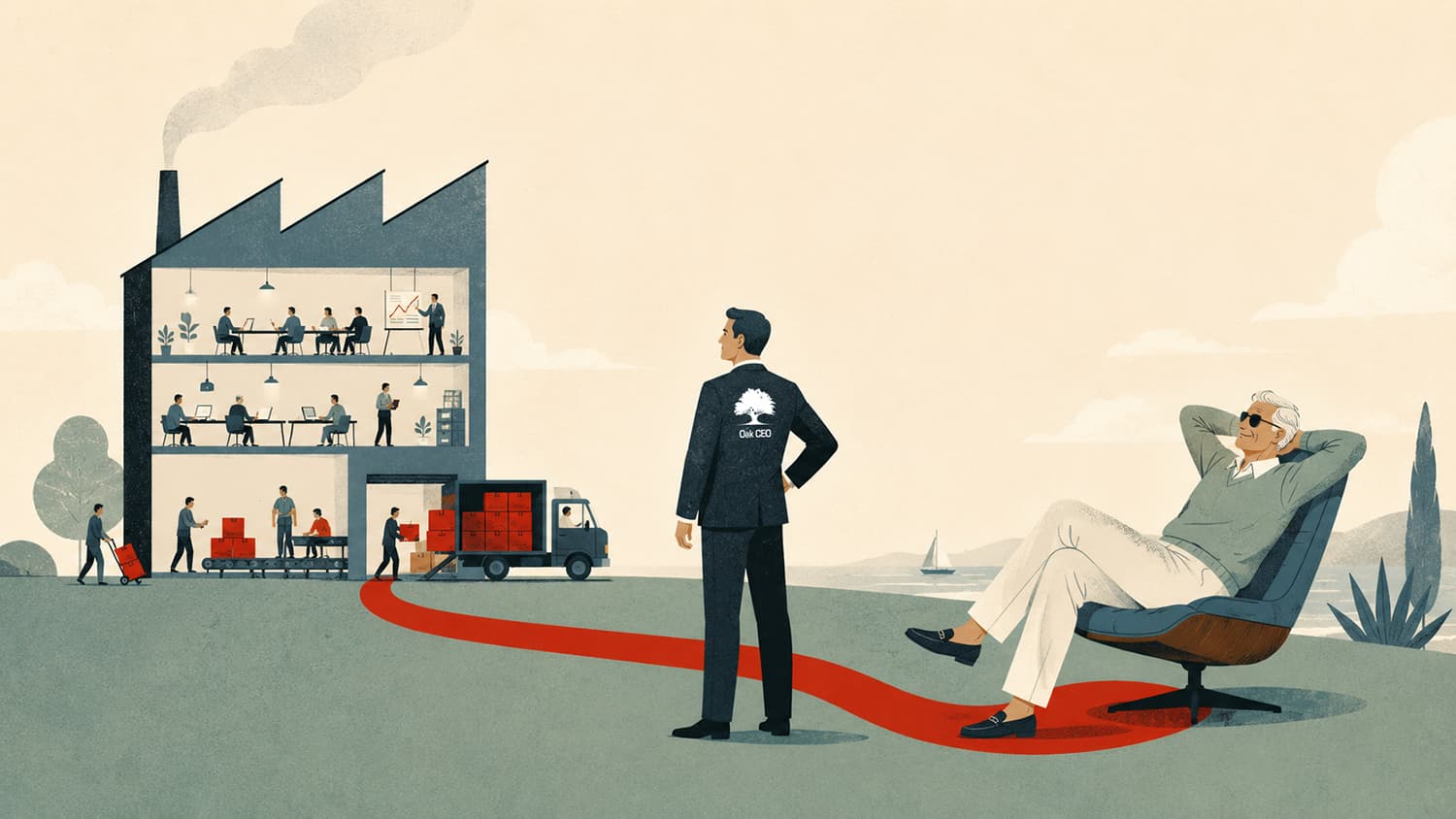
Should I Sell My Business and Retire? Why Most Owners Decide to Keep It
You’ve built the company, it pays you well, and you’re starting to think about life after work. Selling and retiring feels like the natural next step. It’s what everyone around you assumes you’ll do.
But before you call a broker, you should know what happens when owners in your position actually see the numbers. Because most of them, once they understand what their business will really sell for, make a different decision. This article walks you through that math, the trap that catches owners who postpone the decision, and the option that lets you retire without giving up the business.
What You Actually Get When You Sell
Here’s the part that surprises almost every owner I sit down with: a small business typically sells for somewhere around three times its annual profit. The exact multiple varies. Larger, less owner-dependent companies command more, smaller and riskier ones less. But for most owner-led businesses, three years of profit is a realistic expectation.
Say your company reliably puts $500,000 a year in your pocket. A sale will likely bring you somewhere in the neighborhood of $1.5 million. One payment, and the income stream you built over decades belongs to someone else.
When I present a valuation like that, the most common reaction I hear — almost word for word, every time — is:
“Then I might as well work three more years. I get the same money, and I still own the company.”
And they’re not wrong. That instinct is the whole decision in one sentence: selling means trading an income stream that could run indefinitely for a payment worth a few years of it. A buyer pays you three years of profit precisely because they expect to collect year four, five, ten and twenty themselves.
(How that multiple is determined, and what moves it up or down, is its own topic. We cover it in depth in our guide to how much your business is worth.)
The Trap: “I’ll Just Keep Working”
Here’s what I’ve seen happen in practice. Most owners don’t just say they’d rather work three more years. They actually do it. They put the sale on hold and keep running the company.
For a while, that’s genuinely the best financial decision available. The business keeps paying them, and they keep the asset.
But there’s a catch, and it’s not a financial one: nobody can work forever. At some point, age or health makes the decision for you. And when that happens, the timing is no longer yours to choose.
This is where the real problem of most small businesses shows itself: they are built around one person. The owner holds the customer relationships, the supplier knowledge, the pricing judgment, the daily decisions. The business runs because the owner runs it.
That person-dependency does two things, both bad:
- It traps you. You can’t step back, because nobody else can do what you do.
- It erodes the price. A buyer looking at a company that collapses without its owner will discount it heavily, or walk away. The longer you wait, the more the “I’ll just keep working” plan converges on selling a weakened business in a hurry, on someone else’s schedule.
So the honest version of the choice isn’t “sell now or keep working.” It’s: fix the person-dependency now, while you’re healthy and in control — or let it decide your exit for you later.
The Better Option: Retire From the Job, Keep the Company
You don’t actually have to sell your business to retire. What you have to do is replace yourself.
If someone else can run the company well, you can step back to whatever level suits you — board work, a few hours a week, or nothing at all — while the profits keep landing in your account. You keep the income stream the buyer was going to pay you three years of profit to take over. You can have your cake and eat it too.
There are several ways to fill your seat: promote someone internally, recruit a permanent CEO, or hand over within the family (our guide to business succession planning covers that path). But for an owner-led company where no successor is in place, the strongest move I know is to bring in an interim CEO: an experienced executive who steps in, takes over day-to-day leadership, and systematically lifts the business off your shoulders.
Done right, it looks like this:
- Work in parallel for as long as you can. Don’t hand over the keys and leave. If time and health allow, stay alongside the interim CEO and transfer everything you carry in your head: customers, suppliers, pricing, the unwritten rules. The more knowledge that moves from you into the organization, the less the company depends on any one person, including the new CEO.
- Document and delegate as you go. The handover itself becomes the cure for person-dependency. Processes get written down, responsibilities get distributed, and the company learns to run on structure instead of on you.
- Step back at your own pace. There’s no cliff edge. You reduce your involvement as confidence grows, on a schedule set by you, not by your health or a buyer’s deadline.
And the numbers work in your favor. An experienced CEO costs money, certainly. But measured against giving up the entire profit stream for a one-time payment, it’s rarely a close call. A capable operator will often find improvements that fund part of their own cost.
There’s one more benefit worth underlining: even if you ultimately decide to sell someday, a business that runs without its owner is worth meaningfully more than one that doesn’t. Replacing yourself doesn’t close the door on selling. It raises the price behind it.
What We Do in the First 90 Days
Day one sets the trajectory. We map your financial foundations, identify quick wins, and put the right controls in place — so you can move from reactive to strategic in weeks, not quarters.
See the 90-day plan →Our Weekly Oversight Process
Senior expertise on a consistent cadence — reporting, cash flow, KPIs, and board-ready insight delivered week after week. Structure that compounds over time without a full-time salary.
Explore the process →Already Decided? Let’s Talk.
Tell us about your company and what you need. Christoffer will respond within 24 hours with a clear proposal — scope, cadence, and a plan built around your priorities.
Contact us now →When Selling Really Is the Right Call
Keeping the business is the better outcome for most owners, but not for all, and it would be dishonest to pretend otherwise. Selling and retiring makes sense when:
- Your health won’t wait. If you can’t stay involved even for a handover period, a clean sale may be the most responsible path, for you and for your employees.
- The business can’t carry professional management. If margins are too thin to fund a CEO’s compensation, the replace-yourself math doesn’t work.
- The industry is turning. If you genuinely believe the best years are behind the business, three years of profit today can beat five uncertain years of grinding.
- A buyer pays a strategic premium. Occasionally a competitor or acquirer values your company far beyond the standard multiple. At a real premium, the trade can tip in favor of selling.
- You simply want out — completely. Some owners want zero ties: no board seat, no phone calls, no ownership. That’s a legitimate preference, and only you can weigh what it’s worth.
If you land here, sell deliberately rather than reactively. That process is its own discipline, and we walk through it in our guide to business exit planning.
How to Decide: Five Questions
Run your own situation through these five questions, with real numbers rather than gut feel:
- What would the business realistically sell for? Not what you hope — what the multiple says. If you haven’t had it valued, that’s step one.
- What does it pay you per year if you keep it — with someone else running it? Annual profit minus the cost of a CEO. Compare that stream against the sale price.
- Can the business run without you today? If the honest answer is no, that’s not a reason to sell. It’s the first problem to fix, whichever path you choose.
- What would you do with the proceeds? If the answer is “invest it,” compare those expected returns with what the business itself returns. For a healthy company, the business usually wins.
- What do you want your week to look like? Retirement from the workload and retirement from ownership are two different things. Be precise about which one you’re actually after.
If question 5 is “I never want to think about the company again,” selling deserves serious consideration. For almost every other answer, the path runs through replacing yourself, not selling.
FAQ
Talk It Through Before You Decide
This is one of the biggest financial decisions of your life, and it deserves real numbers: a defensible view of what the business would sell for, what it yields if you keep it, and what it would take to make it run without you.
I’ve sat on both sides of this table: valuing companies in M&A processes, and stepping in as interim CEO for owners who decided to keep the asset and retire from the job. If you’re weighing this decision, get in touch. A short conversation about your numbers costs nothing and tends to save owners from their most expensive assumption: that selling is the only way out.
Christoffer Nielsen
Phone: (737) 232-0838
christoffer@oakceo.com